13 Little Blue Envelopes and The Last Little Blue Envelope by Maureen Johnson tell the story of Ginny and the trip she’s sent on by her crazy, runaway aunt, Peg, who has suddenly died. 13 Little Blue Envelopes begins the story with Ginny receiving a letter from her aunt giving her the rules for this adventure she’ll be taking. If she accepts these rules, she is to go to New York to pick up a package filled with clues for her journey. Ginny’s hesitant, she doesn’t normally take random journeys and especially not by herself, but goes along with it. She is whisked away to England where she meets her aunt’s friend, Richard. In following the instructions of the second letter, Ginny meets Keith, a struggling writer/actor who helps her in some of the legs of her journey. Keith goes with Ginny to Edinburgh to find an artist friend of her aunt’s and meets up with her again in Paris. Following this, the letters send Ginny to Amsterdam and Copenhagen, and her trip finishes in Corfu. Along the way Ginny meets more of her aunt’s friends, sneaks into a cemetery in Paris, gets taken in by a very touristy American family, sees the midnight sun, and joins some Australians for the final leg of her trip. In Greece, Ginny’s belongings are stolen and she doesn’t get to find out what is in the last letter. Being stranded in Greece, Ginny calls Richard to help her return to England and then home. Back in England, Ginny discovers secret paintings of her aunt’s which are then put in an auction where they sell extremely well. Ginny’s trip teaches her a lot about her aunt and herself and, despite the disappointing end in Greece, she feels the trip was a success.
The Last Little Blue Envelope picks up shortly after the end of 13 Little Blue Envelopes. Ginny is attempting to write her college application essay and struggling when she gets an email from Oliver in England who found her backpack when he was in Greece, and has her letters. She packs up her things and heads to England over Christmas break to get her letters and to follow the tasks in the thirteenth letter. Oliver tags along with Ginny, and Keith and his girlfriend Ellis come along as well. This time Ginny has to find pieces for her aunt’s last work of art, finding a piece in each Paris, Amsterdam, and Dublin. Along the way Ginny struggles with her old feelings for Keith, as well as any new ones she might have for Oliver.
Both books are quick, fun reads that allow you to take a bit of a European vacation yourself. Johnson’s style is very easy to read and her descriptions of places and events make you feel like you’re there right alongside Ginny and the people she meets. While the books aren’t very deep, they show how important self-assurance can be and how one journey can change everything. These books would be good for anyone in high school, leaning more for girls but fun for anyone.
Sunday, June 5, 2011

Saturday, May 28, 2011

Lauren Oliver’s Delirium is set in an unidentified American future in which the "disease" of love has been cured. Lena is set to have her cure in a few months, and the book follows her from her evaluation – to determine her future partner and schooling – through the summer to right before her cure. In this time Lena finds out that a number of things she has been taught over her life are lies, and that there are more important things than being cured and being "happy."
We are also introduced to Lena’s family, her friend Hana, and Alex, a worker at the center that cures everyone, who has his own secrets.
There are a number of beautiful moments in the book, the descriptions of the scenery around Portland, Maine, is especially well described. There are also a number of dark scenes surrounding the officials who keep everyone in line until they are cured, and the security the government goes to to keep everyone happy and to keep rebels out of the system.
The book is reminiscent in many ways of 1984 by Orwell and the Uglies books by Westerfeld, but has enough of its own unique story to keep it fresh and new. Oliver’s writing style is different and keeps the pace of the story moving right until the end. Delirium is the first of a series and the ending definitely keeps you wanting more. It would be a good read for anyone high school aged or older.
Wednesday, May 25, 2011
The Hate List

A school shooting novel set from the point of view of the girlfriend of the shooter. The Hate List is another in an increasingly popular subgenre of young adult novels about school shootings. Each on explores a different aspect, probes for meaning in different ways, and provides a multitude of vantage points for understanding the incomprehensible. For teenagers.
Friday, May 20, 2011
The Chocolate War
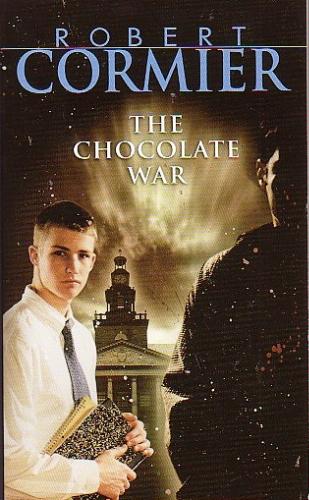
Over the last few days I have been reading The Chocolate War by Robert Cormier. This book has been on my radar for a long time, and I had been putting off reading it until I could sit down and thoroughly enjoy it. It was very much worth the wait. It wasn't exactly what I thought it was going to be be (although what do you expect with a title like The Chocolate War?), but it was a very engulfing read that was over before I knew it.
The story has a main character, but the novel does not revolve around him entirely. It has a shifting point of view, going behind the thoughts of many of the characters. The two characters that readers follow the most are Jerry, the "hero," and Archie, the "villain." There are other minor characters that give multiple vantage points, and so the novel has a realistic texture that captures the mind of the young adult male even though the story is fictitious.
Premise
The setting is Trinity school for boys, a private school run by priests. Father Leon is the acting Head Master, and it is clear from his introduction that he is sadistic. He thrives on the humiliation of his students, manipulating and punishing them to his own personal gain.
The main narrative of the story picks up with the beginning of the annual chocolate sale. Out of all the students, only Jerry refuses to sell the chocolates. This jams a stick in Father Leon's spokes. Leon can't understand why anyone who refuse to help out the school. It comes out that Jerry is acting on behalf of an assignment by the school secret society. However, once the assignment ends and Jerry continues to refuse to sell chocolates, the world is inverted on its axis.
Comments
There are quite a few themes that can be discussed, it is impossible to fit them into one blurb. One of the most important aspects, however, to keep in mind when reading this novel is the power roles: Who has the power? Who wants the power? Who is the powerless? How does this change by the end of the novel?
Another aspect that is very interesting and needs to be addressed is the part when Jerry is confronted by Emile, a bully, and is called a homosexual. There is a line where Jerry expresses that there is nothing worse in the world than being accused of being gay. The reason this is such an important line is because it sheds light on a juvenile male anxiety of sexuality. It is perhaps a truism that teenage males, regardless of their sexual orientation are afraid of being humiliated for their emerging sexuality. This axiom is clearly expressed by many of the characters throughout the novel.
The theme of authority is interestingly presented in this novel. The teachers of the novel seem to pose and direct opposition to the students, while the parents are all absent. Jerry's father is in the novel, but only as a means of showing how disconnected Jerry is with his nuclear family as the result of his mother's death. This is a recurring theme in fiction for young adults. The idea of the nuclear family is dissolved in one way or another. Additionally, the parental figures are shown in positions in which they have become powerless, or at least have little power over the actions of the young adult character.
So, I recommend this to everyone, but especially to teen-aged boys 13-17.
Tuesday, May 17, 2011
Paul Zindel, changing times, and Young Adult Drama

The premise of The Effects of Gamma Rays on Man-In-The-Moon Marigolds follows a mother and her two daughters as the go about their daily lives. The mother, however, does not think the girls should be going to school. She believes that they should be attending to their domestic duties. One daughter, Tillie (short for Matilda) is an intelligent student who is enthusiastic about science. The other daughter, Tillie has been kept home for so long that the school is calling on account of her truency. The mother, Beatrice, displays typical anti-intellectual attitudes, especially towards the daughters' schooling.
This play occurs during a period of time when America was shifting into post-modernity. To that extent, there is a disconnect between the parent, who belongs to an era before mass education and the children who are living in a time of intellectual freedom as well as an approaching civil equality between the sexes. Zindel has done an affective job at characterizing the post-nuclear family: the father is absent, dead since the beginning of the story, the daughters each come to represent a different attitude of their generation, and the mother is clinging to conventional ideas about the sexes and what women should and should not be doing. This is a theme to watch out for in YA literature.
Younger readers should sympathize to some degree with the daughters and the conflicting authority figures between home and school. The genre of young adult literature arose out of the desire to portray those young people who are both caught between the margin of child and adult, but also for those who might still be children if not for adult circumstances forcing them into maturity. This is one of the touchstones of YA literature, showing young people, too old to be children or too mature to be thought of as children, caught in a difficult situation that they must learn to handle like adults. The situations are not realistic in all cases, but they present a kind of life that may be true for some, but all will empathize with. In the case with The Effects of Gamma Rays on Man-In-The-Moon Marigolds perhaps creates a caricature of anachronistic attitudes post-WWII, but it vividly expresses some of the dangers of those attitudes when they are allowed to play out.
Wednesday, May 11, 2011
Monster and the Justice System
Yesterday I had the pleasure of reading a book that has been sitting on my to-read list for over a year now. Had I known it was only a 2 hour read, I probably would have gotten to it much sooner. At any rate, I read Walter Dean Myers's Monster which is split between a first person prison journal and a screen play for the teenaged prisoner the story revolves around.
Steve Harmon was in the wrong place at the wrong time. He was fingered by a neighborhood acquaintance as a look-out man for a stickup heist that ended with the death of a drugstore owner. The screenplay is based on the trial that followed after one of the two people involved in the stickup implicated Steve in order to spread the blame around and lessen his own sentence.
*SPOILER ALERT*
The books is transparent as to Steve's innocence. Whether or not he will be acquitted is up in the air until the end of the novel. The novel's suspense exists in this aspect; the judgment of the jury and the rhetoric of the prosecuting attorney left me as the reader anxious. Would the DA be able to convince the jury that Steve was in fact innocent? Would the Prosecutor's closing argument smear the lucidity of the defenses argument? You'll have to read it yourself to find out.

For more information, check out Barnes & Noble and Amazon for reviews, awards, and ordering.
Coming up... Paul Zindel's The Effect of Gamma Rays on Man-in-the-Moon Marigolds and Nancy Farmer's The House of the Scorpion.
Steve Harmon was in the wrong place at the wrong time. He was fingered by a neighborhood acquaintance as a look-out man for a stickup heist that ended with the death of a drugstore owner. The screenplay is based on the trial that followed after one of the two people involved in the stickup implicated Steve in order to spread the blame around and lessen his own sentence.
*SPOILER ALERT*
The books is transparent as to Steve's innocence. Whether or not he will be acquitted is up in the air until the end of the novel. The novel's suspense exists in this aspect; the judgment of the jury and the rhetoric of the prosecuting attorney left me as the reader anxious. Would the DA be able to convince the jury that Steve was in fact innocent? Would the Prosecutor's closing argument smear the lucidity of the defenses argument? You'll have to read it yourself to find out.

For more information, check out Barnes & Noble and Amazon for reviews, awards, and ordering.
Coming up... Paul Zindel's The Effect of Gamma Rays on Man-in-the-Moon Marigolds and Nancy Farmer's The House of the Scorpion.
Tuesday, May 10, 2011
The End is Near
Today I read a young adult novel that came up in class, but that I had really wanted to re-read. It's called Armageddon Summer by Jane Yolen and Bruce Coville. I highly recommend this book to anyone who has ever encountered any kind of fundamentalist religion. The book revolves around two characters, male and female, who have a parent who has become swept up in a sect of Christianity that emphasizes the end of days coming with the Millennium.
Reverend Beelson, a charismatic and convincing minister, and his Believers are convinced that the end of the world will occur on July 27, 2000. Two teenagers get caught up in the middle, and they are forced to evaluate and re-evaluate what they believe as the End Day approaches. Coville and Yolen portray authentic teenagers in fictional, yet realistic situations.
I like YA novels that can serve dually as a good story and a cautionary tale. (Here is where it gets slightly political--quit reading now if that's not your thing.) Armageddon Summer is a fictitious account of one exegesis* to Christianity, or any faith that preaches an "End of the World." One of the things I find that this book expresses is how people take their interpretations of materials like the Bible, and reify** metaphors and figurative speech. It doesn't matter if God is orchestrating existence if people are acting on their own convictions, causing real consequences via misunderstanding or reducing what is meant to be complicated. People may desire simplicity, but it is nothing more than a desire. Simplicity for the sake of making things simple can remove one by varying degrees of what is true. These are the dangers that seem to be put forward by Armageddon Summer, which is why I recommend it so highly. And for the record, I don't believe we are living anywhere near the "End of Days." I think things will continue to get worse and worse regardless of what people do on behalf of their belief.

For more information, check out the amazon page
*exegesis is a fancy word for "how it plays out"
** reify is another fancy word, it basically means "to treat as real," or to make what is abstract concrete.
Reverend Beelson, a charismatic and convincing minister, and his Believers are convinced that the end of the world will occur on July 27, 2000. Two teenagers get caught up in the middle, and they are forced to evaluate and re-evaluate what they believe as the End Day approaches. Coville and Yolen portray authentic teenagers in fictional, yet realistic situations.
I like YA novels that can serve dually as a good story and a cautionary tale. (Here is where it gets slightly political--quit reading now if that's not your thing.) Armageddon Summer is a fictitious account of one exegesis* to Christianity, or any faith that preaches an "End of the World." One of the things I find that this book expresses is how people take their interpretations of materials like the Bible, and reify** metaphors and figurative speech. It doesn't matter if God is orchestrating existence if people are acting on their own convictions, causing real consequences via misunderstanding or reducing what is meant to be complicated. People may desire simplicity, but it is nothing more than a desire. Simplicity for the sake of making things simple can remove one by varying degrees of what is true. These are the dangers that seem to be put forward by Armageddon Summer, which is why I recommend it so highly. And for the record, I don't believe we are living anywhere near the "End of Days." I think things will continue to get worse and worse regardless of what people do on behalf of their belief.
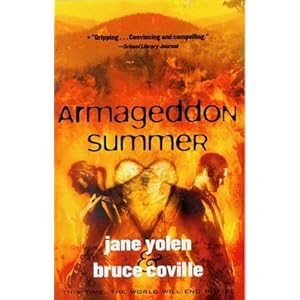
For more information, check out the amazon page
*exegesis is a fancy word for "how it plays out"
** reify is another fancy word, it basically means "to treat as real," or to make what is abstract concrete.
Subscribe to:
Posts (Atom)